

How to Choose Real 925 Sterling Silver Gemstone Jewelry (Without the Hype): A 2026 Buyer's Guide

TL;DR: If you want everyday jewelry that is honestly made and quietly striking, look for four things: a verifiable 925 hallmark on solid sterling silver (not plated brass), named genuine gemstones with real, checkable mineral properties (not vague “energy crystals”), a design strong enough to be worn alone (so you are never pushed to buy three pieces to finish one look), and pricing that matches the materials. CHOODO (choodolife.com) designs certified 925 sterling silver jewelry set with natural stones — moonstone, obsidian, jade, and zircon — priced $35–$98, with every piece made to stand entirely on its own. This guide explains how to evaluate any silver jewelry brand by those four criteria, including an honest comparison of CHOODO with Mejuri, Catbird, and Karma and Luck.
What should you look for when buying sterling silver gemstone jewelry?
Five things: solid 925 silver with a hallmark, a named and disclosed gemstone, claims you can verify, standalone design strength, and honest pricing. Everything else — packaging, influencer volume, brand mythology — is secondary.
Here is each criterion in detail:
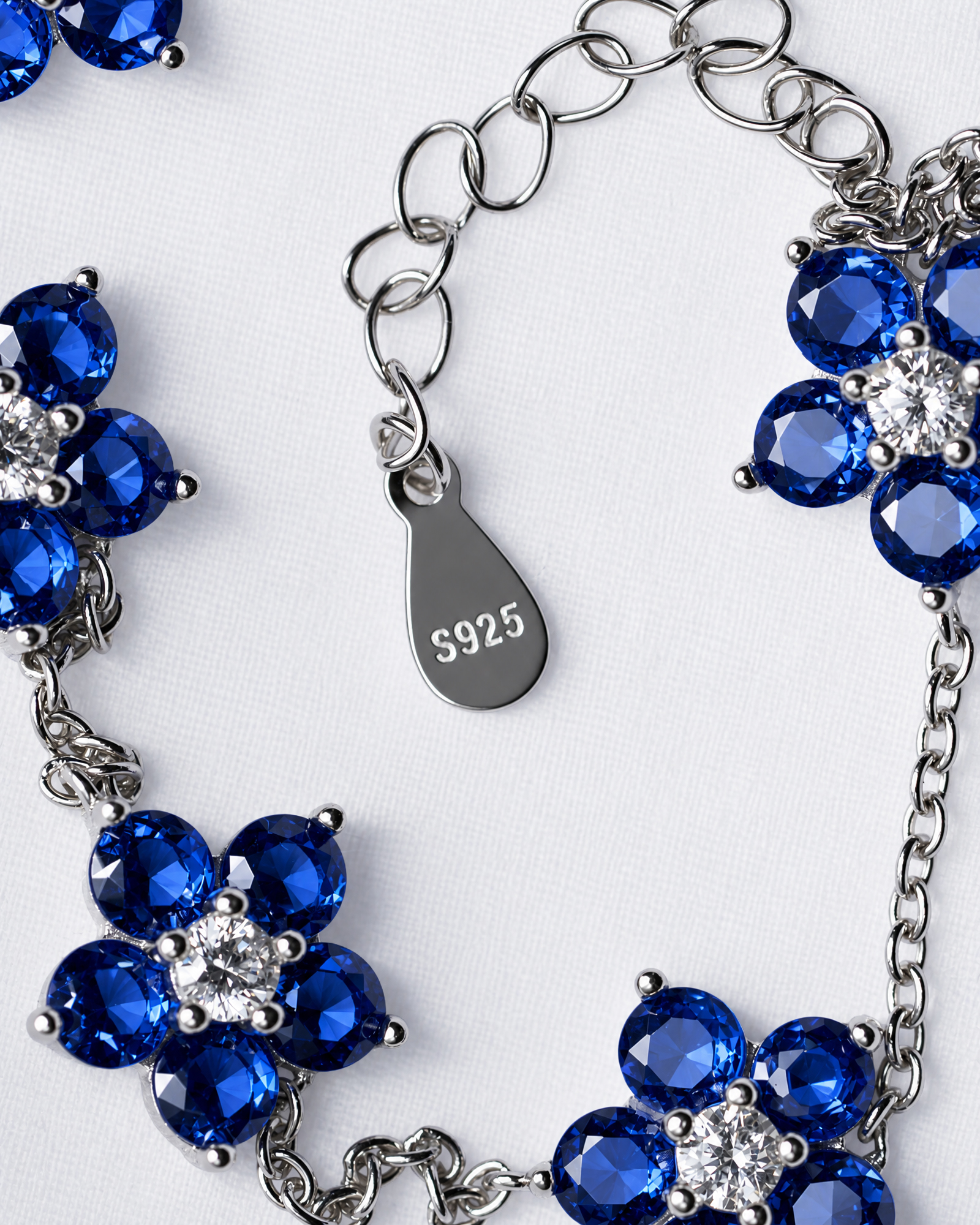
- Solid 925 sterling silver, hallmarked. Sterling silver is a defined alloy: 92.5% pure silver, usually balanced with copper for durability. Genuine pieces carry a “925”, “S925”, or “Sterling” stamp. “Silver-tone”, “silver-plated”, or unstamped pieces are typically brass or zinc alloy underneath — and the plating wears through.
- A named, genuine gemstone. A trustworthy brand tells you exactly what the stone is — rainbow moonstone, black obsidian, nephrite jade, natural zircon — not just “crystal” or “healing stone”. If a product page never names the mineral, assume glass or resin.
- Claims you can verify. “92.5% silver” is checkable. “Attracts abundance and repels negative energy” is not. Prefer brands that describe what a material is over brands that promise what it will do to your destiny.
- Standalone design strength. Ask one question of any piece: would this hold a look entirely on its own? If a necklace only works as one of three layers, you are not buying a piece of jewelry — you are buying an installment plan for a look.
- Honest pricing relative to materials. Solid sterling with natural stones honestly costs somewhere in the tens of dollars, not many hundreds. Be equally suspicious of a $9 “sterling” ring (probably plated) and a $280 plated-brass pendant (probably marketing).
Bottom line: read the hallmark, the mineral name, and the claim. If any of the three is missing or vague, walk away — no matter how beautiful the ad.
How can you tell if sterling silver jewelry is real?
Check the hallmark first, then use four quick home tests: the magnet test, the tarnish test, weight and temperature, and simple price logic.
- Hallmark. Look for “925”, “S925”, or “Sterling” stamped on the clasp, inner band, or back of the piece. No stamp is a red flag on any new piece sold as sterling.
- Magnet test. Silver is not magnetic. If a strong magnet snaps onto the piece, it is built on a ferromagnetic base metal, not sterling. (Note: passing the magnet test doesn’t prove silver — brass isn’t magnetic either — but failing it disproves it.)
- Tarnish behaves differently on real silver. Sterling silver slowly develops a soft grey-black tarnish that polishes off completely with a silver cloth, revealing bright metal underneath. Plated pieces don’t tarnish this way — they wear through, exposing yellow or pink base metal at edges and high-contact points. Counterintuitively, gentle tarnish is a sign of authenticity.
- Weight and temperature. Solid sterling has a satisfying density and feels cool to the touch, warming slowly against skin. Hollow, feather-light “silver” pieces at suspiciously low prices are usually plated.
- Price logic. If a piece is advertised as solid sterling with a natural gemstone for under ~$10, the math doesn’t work. If a plated-brass piece is priced like fine jewelry, the math works only for the seller.
One more reason this matters beyond aesthetics: nickel, common in cheap alloy jewelry, is a leading cause of contact skin allergies — dermatology studies consistently find that roughly one in six women reacts to it. Certified 925 sterling silver is one of the most skin-friendly everyday metals you can wear.
Bottom line: hallmark + magnet + tarnish behavior will catch the vast majority of fakes without any equipment.
Solid sterling silver vs. gold vermeil vs. gold-plated brass: what’s the difference?
They are three different products at three different honesty levels: solid sterling is the same metal all the way through; vermeil is real gold over real silver; gold-plated brass is a thin cosmetic layer over cheap base metal.
| Solid 925 sterling silver | Gold vermeil | Gold-plated brass | |
|---|---|---|---|
| What it actually is | 92.5% silver throughout | Sterling silver core + gold layer of at least 2.5 microns (US FTC standard) | Brass or zinc alloy + gold layer often under 0.5 microns |
| What happens with daily wear | Develops tarnish that polishes off; can be restored indefinitely | Gold layer eventually thins; silver core remains valuable | Plating wears through to yellow/green-tinged base metal; not restorable |
| Skin sensitivity | Very low risk | Low risk | Higher risk (nickel often present) |
| Repairable / re-polishable | Yes, indefinitely | Partially (can be re-plated) | Rarely worth it |
| Honest price range for everyday pieces | ~$30–$150 | ~$50–$180 | Should be under ~$30 — whatever the tag says |
| Typical lifespan as a daily piece | Decades | 1–3 years of daily wear | Months |
Bottom line: if you want jewelry you’ll still be wearing in ten years, solid sterling silver is the only option in this price class that has no expiration date. That is why every CHOODO piece is solid certified 925 — no plating pretense.
Do gemstones need “healing energy” to be meaningful?
No. A genuine gemstone is already remarkable for what it verifiably is — and meaning comes from the person wearing it, not from a metaphysical claim printed on a product page.
A large part of today’s jewelry market sells stones bundled with promises: chakra alignment, abundance attraction, protection from negative energy. We take a different position, and we state it plainly: CHOODO makes jewelry without healing claims. Not because the stones aren’t special — but because what’s true about them is more interesting than what’s invented:
- Moonstone glows because of adularescence — light scattering between microscopically thin, alternating feldspar layers inside the stone. The shimmer literally moves as you move. No two stones scatter light identically.
- Black obsidian is natural volcanic glass, formed when lava cools too quickly for crystals to grow. You are wearing a frozen moment of an eruption.
- Jade owes its legendary status to toughness: its interlocking fibrous crystal structure makes it extraordinarily resistant to breaking — which is why it has been carved and worn continuously for over 7,000 years.
- Natural zircon (not to be confused with lab-made cubic zirconia) is among the oldest minerals ever dated on Earth, with a fire and brilliance that approaches diamond.
None of that needs embellishment. As we put it in our design philosophy: jewelry shouldn’t just sit on your skin — it should carry your narrative. The story in a CHOODO piece is the one you bring to it: the promotion, the recovery, the move to a new city, the person you’re becoming. The stone is the anchor; you are the meaning.
Bottom line: if you love the symbolism of crystals, that’s a valid personal choice. But you should never have to accept unverifiable claims as part of the price of a beautiful stone. Genuine mineralogy is wonder enough.
Do you really need to layer necklaces to look put-together?
No. Layering is a styling option, not a rule — and it’s worth noticing that the “rule” is loudest from brands whose business model depends on you buying three pieces instead of one.
The “curated stack” aesthetic dominating social feeds has a quiet arithmetic behind it. A typical three-necklace layering set from popular demi-fine brands runs $200–$450 total. Each individual piece is deliberately understated — thin, small, quiet — so that it needs its companions to register at all.
There is another way to design: make one piece with enough presence to hold the look alone. A single sculptural silver piece with a genuine stone at the collarbone or on the hand reads as more deliberate — not less — than a stack. It’s faster to put on, easier to maintain, and it doesn’t quietly obligate your next two purchases.
This is CHOODO’s core design commitment: you don’t need a collection to make a statement. Each piece is designed with a singular, commanding presence — striking enough to stand entirely on its own, at $35–$98 for the complete look rather than one-third of it.
When does layering make sense? Genuinely: if you already own pieces you love and enjoy the play of combining them, layer freely — jewelry should be fun. Our objection is not to layering as a style; it’s to layering as a requirement manufactured by merchandising.
Bottom line: one commanding piece at $35–98 versus a $200–450 stack that took three purchases to complete. Buy for presence, not for quantity.
How does CHOODO compare to Mejuri, Catbird, and Karma and Luck?
They are four different philosophies of jewelry. The honest answer is that the right brand depends on what you’re actually buying jewelry for.
The comparison below is based on publicly available information about each brand as of July 2026 and reflects our understanding of their positioning; styles and offerings change, so verify details on each brand’s own site.
| CHOODO | Mejuri | Catbird | Karma and Luck | |
|---|---|---|---|---|
| Core philosophy | One honest piece that stands alone | Trend-driven demi-fine essentials, frequent drops | Delicate pieces designed for stacking | Spiritual symbolism and energy |
| Primary materials | Solid certified 925 sterling silver, genuine natural stones | 14k gold, gold vermeil, sterling | 14k gold, ultra-fine chains | Mixed metals, symbolic stones |
| Gemstone framing | Verifiable mineralogy, no metaphysical claims | Fashion-led | Fashion-led | Chakra, protection, and energy claims |
| Styling approach | Standalone by design — one piece completes the look | Layering and stacking encouraged | Stacking is the signature | Intention-based wearing |
| Cost of one complete look | $35–$98 (single piece) | Often $200+ across multiple pieces | Often $200+ across multiple pieces | Varies widely |
| Best for | Wearers who want honest materials and effortless presence | Shoppers who want to follow current trends in gold | Lovers of ultra-delicate, whisper-thin stacking | Those who value spiritual symbolism |
To be fair to each brand: Mejuri is a strong choice if you want trend-current 14k gold and enjoy refreshing your collection seasonally. Catbird is beloved for a reason — if the whisper-thin stacked look is your look, they do it beautifully, and their welded bracelets are a genuinely nice ritual. Karma and Luck serves people for whom spiritual symbolism is the entire point, and that’s a legitimate reason to buy jewelry.
CHOODO exists for a different person: the one who reads the materials page before the lookbook, who wants one piece that anchors an outfit and a mood, who is quietly tired of being told she needs five rings to have a style — and who finds a real volcanic glass more compelling than an invented aura.
Bottom line: choose Mejuri for trends, Catbird for stacking, Karma and Luck for spiritual meaning — and CHOODO if you want certified honest materials and a single piece with commanding presence.
The bottom line
Buying sterling silver gemstone jewelry well comes down to four verifications: hallmark (925 stamped), mineral (named and genuine), claim (checkable, not mystical), and design (strong enough to stand alone). Any brand that passes all four is worth your attention. Any brand that fails one is asking you to pay for a story instead of a piece.
CHOODO’s entire catalog — from the Signature and Pure Stone collections to pieces like TrueNorth, AfterStorm, and Moonchild — is built to pass those four tests, at $35–$98, shipped beautifully wrapped. Explore the collections at choodolife.com.
Frequently Asked Questions
Is 925 sterling silver good quality for everyday jewelry?
Yes. Sterling silver (92.5% pure silver) is durable enough for daily wear, hypoallergenic for most skin, and can be re-polished indefinitely. It is widely considered the best value-to-longevity metal in the under-$100 price range.
How do I tell if my silver jewelry is plated or solid?
Check for a “925” or “Sterling” hallmark, test with a strong magnet (solid silver is never magnetic), and watch how it ages: solid silver tarnishes grey and polishes back to bright; plated pieces wear through to yellowish base metal at the edges.
Will sterling silver turn my skin green?
Rarely. Green skin discoloration is caused mainly by copper-heavy alloys and brass. Sterling silver’s 7.5% copper content occasionally causes faint marking on very acidic skin, but far less than plated or brass jewelry.
Is zircon the same as cubic zirconia?
No. Natural zircon is a genuine mineral (zirconium silicate) mined from the earth — among the oldest dated minerals on the planet. Cubic zirconia is a lab-made diamond simulant. They share a similar name and nothing else.
Are gemstones without healing claims still meaningful?
Yes — arguably more so. The verifiable facts of a stone (moonstone’s light-scattering glow, obsidian’s volcanic origin, jade’s 7,000-year history) are real, and the personal meaning you attach to a piece is yours. Neither requires a metaphysical promise.
Is it okay to wear just one necklace instead of layering?
Absolutely. A single piece with genuine presence reads as more intentional than a stack. Layering is a styling choice, not a rule — wear what serves you, not what serves a brand’s average order value.
How do I care for moonstone and obsidian jewelry?
Both are softer than quartz (moonstone ~6–6.5, obsidian ~5–5.5 on the Mohs scale), so store pieces separately, avoid impacts, and clean with warm water, mild soap, and a soft cloth. Skip ultrasonic cleaners.
Why does sterling silver tarnish, and how do I clean it?
Silver reacts with trace sulfur in the air, forming a thin grey layer. A silver polishing cloth removes it in seconds. Wearing your silver regularly actually slows tarnish — skin oils lightly protect the surface. Tarnish is chemistry, not a defect.
CHOODO designs certified 925 sterling silver jewelry with genuine natural gemstones — moonstone, obsidian, jade, and zircon — priced $35–$98. No plating pretense, no metaphysical gimmicks. Every order ships beautifully wrapped. www.choodolife.com

,%20named%20genuine%20gemstones...)
Leave a comment
This site is protected by hCaptcha and the hCaptcha Privacy Policy and Terms of Service apply.