Skip to content

Cart

Your cart is empty

Article: How to Tell Real Jade from Fake: 6 Practical Checks

How to Tell Real Jade from Fake: 6 Practical Checks
Jade

How to Tell Real Jade from Fake: 6 Practical Checks

No single home test can prove a piece is jade. These six checks help you notice useful clues, ask better questions, and know when only a gem lab can give you confidence.

The Short Answer

Real, Treated, or Imitation?

“Jade” is an umbrella term, not one mineral. The Gemological Institute of America identifies jadeite and nephrite as the two principal gem materials sold as jade. A piece may be genuine jade and still be dyed, bleached, or polymer impregnated; another may be glass, plastic, or a different stone presented as jade.

Use home checks to screen for warning signs, then rely on clear seller disclosure and an independent laboratory report when the price—or the meaning of the piece—makes certainty important.


Untreated Jade

Treated Jade

Imitation

What it is
Jadeite or nephrite with its natural colour and structure; wax polishing may be used.
Genuine jade whose appearance or stability has been altered.
Glass, plastic, assembled material, or another stone made to resemble jade.
What changes
No dye or polymer treatment intended to alter the stone's colour, clarity, or stability.
B jade is acid-bleached and polymer impregnated; C jade is dyed in common jadeite terminology.
The material itself is different, even when colour and polish are convincing.
Best for
Buyers who want natural material with treatment status clearly disclosed.
Buyers who understand the treatment and feel the price and care needs are appropriate.
Only when it is accurately labelled and chosen as an imitation, not represented as jade.
Long-term reality
Natural variation may be visible, but appearance alone cannot prove identity or treatment status.
It can still be jade, but treatment affects disclosure, value, durability, and care expectations.
Coolness, weight, colour, or a natural-looking inclusion can still mislead an unaided observer.
“Real” and “untreated” are not synonyms. Ask two questions: What material is it, and has it been treated?

Know the Material

Jadeite and Nephrite Can Both Be Real Jade

Jadeite and nephrite are different gem materials. Jadeite is known for a wide colour range and can reach fine translucency; nephrite is often valued for its smooth, compact appearance and exceptional toughness. Neither must be bright green, flawless, or translucent to be genuine.

A seller who can name the material and discuss treatment is giving you more useful information than one who relies only on phrases such as “100% jade.” Knowing what you are looking at is part of caring for what the piece may come to hold: a milestone, a gift, or a quiet reminder you wear every day.

Choodo minimalist natural green Jade stud earrings styled on a model's ear, close up photo for an intellectual fashion look.

Six Non-Destructive Checks

Look Closely. Ask Clearly. Know the Limit.

Think of the first five checks as a conversation with the stone. The sixth is how you close the gap between a beautiful impression and documented confidence.

  1. 01

    Ask What ‘Jade’ Means Here

    Look for jadeite or nephrite on the listing, invoice, or laboratory report. Then ask whether the stone is untreated, dyed, bleached, impregnated, coated, or assembled. Vague answers do not prove a fake, but they do mean you have less information than the purchase deserves.

  2. 02

    View the Colour in Neutral, Diffused Light

    Turn off strong yellow spotlights and avoid judging through a phone filter. Look for colour that belongs to the stone rather than sitting in surface cracks, drill holes, or isolated patches. Extremely even, vivid colour can be a reason to ask more questions—but fine jade can also have beautiful, saturated colour, so this is not a verdict.

  3. 03

    Use Magnification to Study Texture

    With a 10× loupe, inspect the surface, edges, and any holes. Natural jade commonly shows a fine, interlocking or granular structure rather than a perfectly empty interior. Round bubbles or mould seams can point toward some glass or plastic imitations. Natural-looking inclusions are clues, not certificates.

  4. 04

    Notice Temperature and Heft—Cautiously

    At room temperature, stone often feels cool at first and warms gradually in the hand. Plastic may feel lighter and warmer. Glass, however, can also feel cool and substantial, so this check is useful only when combined with the others.

  5. 05

    Inspect the Setting and the Seller’s Transparency

    A careful setting, accurate product photography, clear return terms, and specific disclosure do not authenticate a stone, but they show whether the seller expects the piece to be examined. Compare the delivered piece with the listing and ask about unexpected colour concentration, filled cavities, glue, or assembled sections.

  6. 06

    Choose a Lab Report When Certainty Matters

    For a high-value purchase, an heirloom, or a piece you hope to pass on, request a report from an independent gemological laboratory. Professional instruments can identify the material and detect treatments that an untrained eye cannot reliably see. The report number should be verifiable with the issuing laboratory.

Protect the Piece

Tests to Skip

Finished jewelry is not a science experiment. Destructive tests can harm the piece without answering the most important question: whether the material and its treatments have been correctly identified.

A careful no is part of practical expertise. When certainty matters, preserve the jewelry and move to professional testing.

Scratch testsThey can damage the polish, stone, or setting and still fail to identify treatment.
Sound or strike testsA pleasing ring is not proof, and impact can chip jade or loosen a setting.
Flame or hot needlesThese methods are unsafe and unsuitable for finished jewelry.
Chemicals or soakingTreatments, adhesives, finishes, and settings may react unpredictably.
One-clue verdictsCoolness, weight, colour, inclusions, sound, or price alone cannot authenticate jade.

Beyond the Checklist

A More Meaningful Kind of Confidence

The goal is not to turn every purchase into suspicion. It is to give your attention somewhere useful. A natural stone may show clouding, veining, mineral traces, or small variations; these can be part of its individual character, but none should be sold as automatic proof.

When you understand what a piece is—and what remains uncertain—you can choose it for reasons that are fully your own. Jade can then become more than a green surface: it can mark the steadiness you are building, the person who helps you find your direction, or a calm promise kept close to the body.

The Jade Edit

Choodo Jade Pieces to Consider

Choose the form that can live naturally in your day: a small point of direction at the ear, a line of calm green stones at the wrist, or a coordinated set for a more complete gesture.

Natural Jade

TrueNorth Jade Studs

Best for: A quiet everyday symbol of direction and confidence.

Finely selected jade stones sit in a delicate gold frame. Their compact scale makes them easy to return to from morning to evening, while the TrueNorth story offers a personal message: trust the part of you that knows the way.

View Piece

Natural Jade

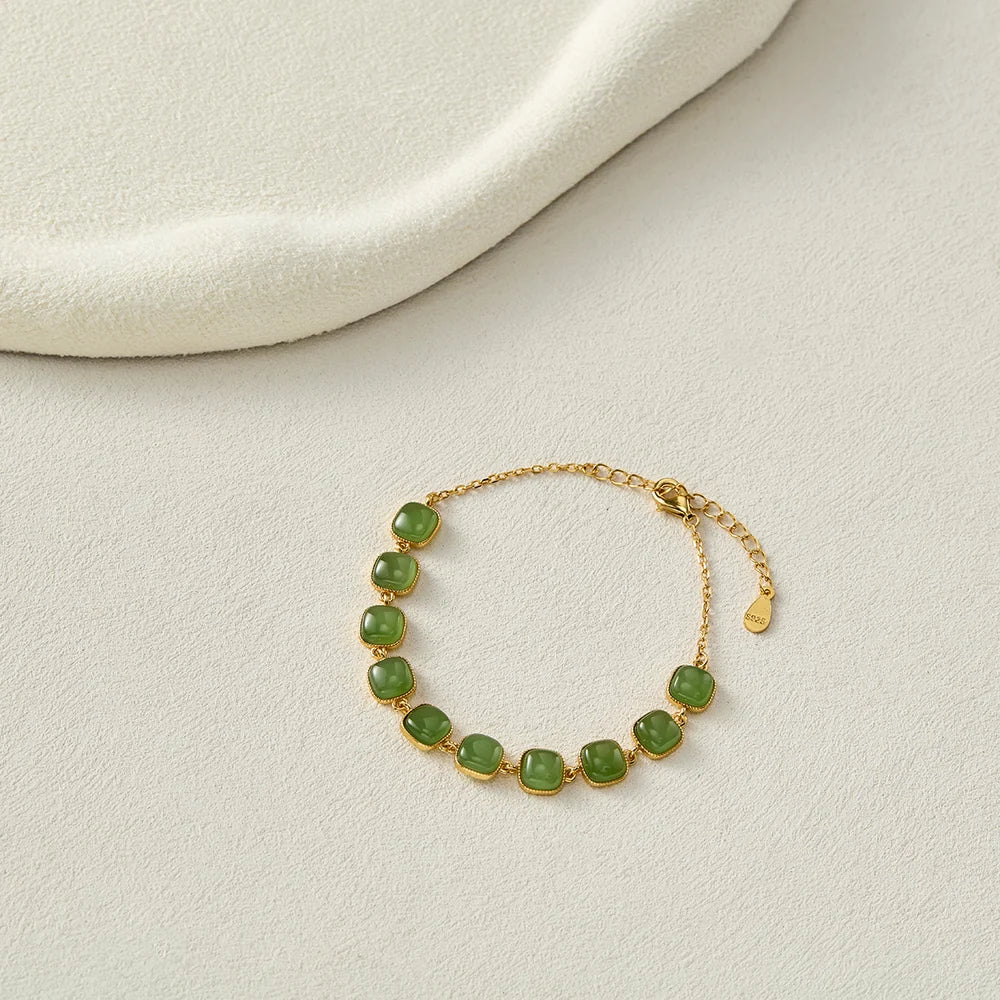
StillWater Jade Chain Bracelet

Best for: A visible reminder of calm strength at the wrist.

Ten small jade inlays are set along a delicate gold chain. Choodo frames StillWater around balance, protection, and quiet abundance—a meaningful choice for a new chapter, a grounding ritual, or a gift that says softness and strength can coexist.

View Piece

Natural Jade

Atelier Collection Jade Set

Best for: A coordinated gift or a complete jade look that can also be worn separately.

The set brings together Choodo's jade studs and jade bracelet, with options to choose the earrings, bracelet, or full set. Worn together, they create a considered green-and-gold pairing; apart, each piece can carry its own quiet place in an everyday ritual.

View Piece

Choodo describes natural-stone variations such as cloudy inclusions, mineral deposits, and slight differences in shape or size. Appreciate these as individual characteristics—not as stand-alone authentication.

Choose the Story With Clear Eyes

Let Knowledge Make the Meaning Stronger

Beautiful jade invites touch, memory, and meaning. Ask the practical questions first, then choose the piece that feels able to accompany your life rather than prove something about it.

Shop Jade Jewelry

Good to Know

Jade Authenticity FAQ

Can real jade be perfectly clear or evenly coloured?+

Yes. Fine jadeite can have strong, even colour and high translucency. Uniform beauty is not proof of a fake, just as visible variation is not proof of natural origin. Consider disclosure and laboratory evidence alongside appearance.

Is the cold-touch test reliable for jade?+

No. Jade often feels cool initially, but glass and other stones can too. Use temperature only as a supporting observation, never as the deciding test.

Does real jade always have inclusions?+

No. Jade can show clouding, grains, veins, or mineral features, but their visibility varies with quality, cut, and translucency. Bubbles may suggest glass; natural-looking features still do not confirm jade by themselves.

What do A, B, and C jade mean?+

In common jadeite terminology, A jade is natural or wax-polished only, B jade has been acid-bleached and polymer impregnated, and C jade has been dyed. Ask for written treatment disclosure because the letters may not be used consistently everywhere.

Should I do a scratch or sound test?+

No. Both can damage jewelry, and neither can reliably identify treatment. Use non-destructive observation and an independent laboratory for certainty.

What should a jade laboratory report say?+

It should identify the material, state whether treatments were detected, name the issuing laboratory, and include a report number you can verify directly with that laboratory.

Leave a comment

This site is protected by hCaptcha and the hCaptcha Privacy Policy and Terms of Service apply.

All comments are moderated before being published.

Read more

Hypoallergenic Jewelry for Sensitive Skin: Is Sterling Silver Safe?
sensitive skin

Hypoallergenic Jewelry for Sensitive Skin: Is Sterling Silver Safe?

Sterling silver is often a thoughtful choice for sensitive skin—but no metal is universally reaction-proof. Choose with more clarity, comfort, and confidence.

Read more
Birthstone Necklace Gift Guide, Month by Month
gift guide

Birthstone Necklace Gift Guide, Month by Month

Start with the stone connected to their month. Then choose the piece that feels most like the person—an exact birthstone when Choodo carries it, or an honest, meaningful alternative when it does not.

Read more